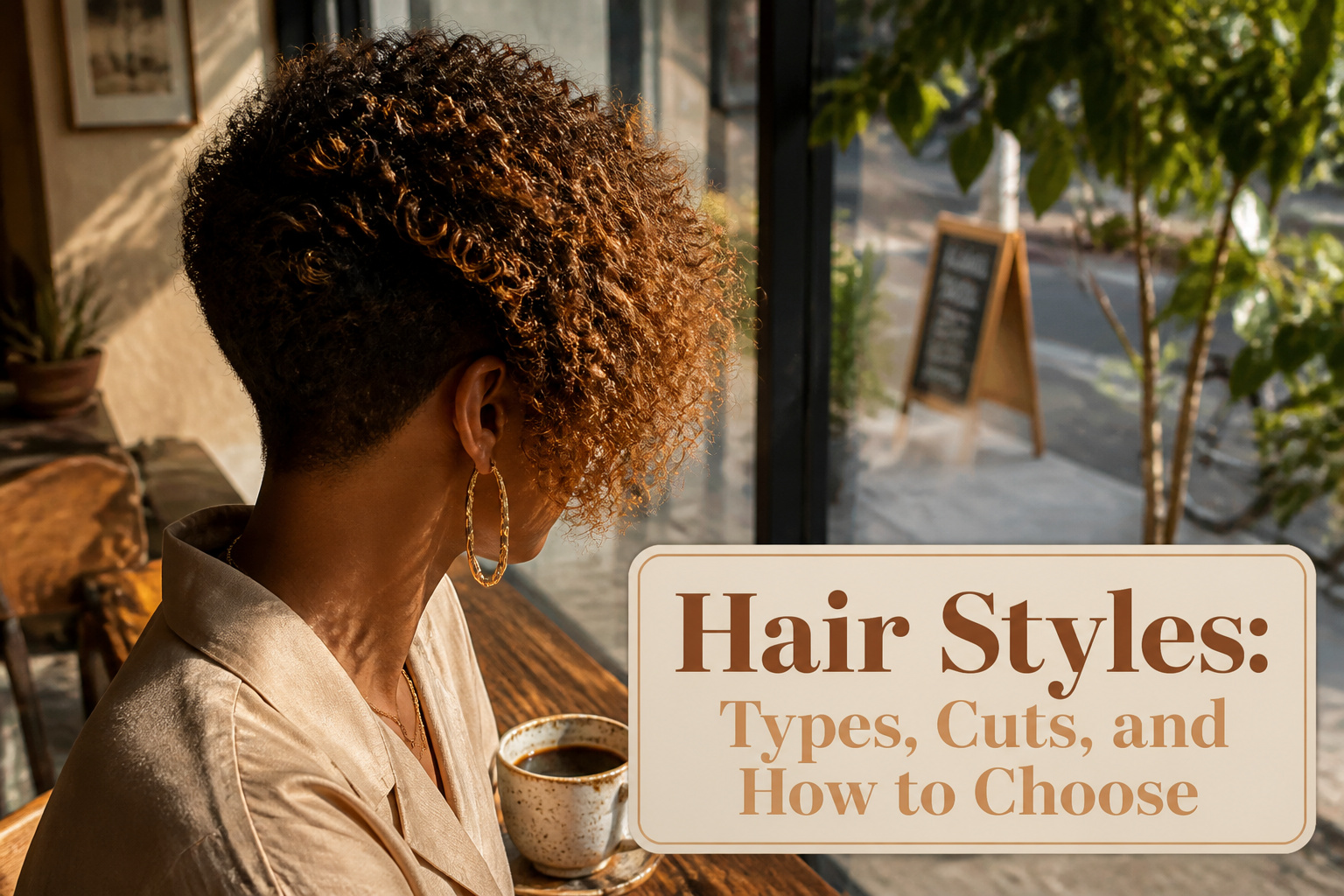
Hair styles are the cuts, lengths, and arrangements you choose for your hair, from a 1920s bob to a protective style you sleep in for weeks. The same choice carries entirely different weight depending on your texture, your budget, and whether you are walking into a barbershop or a salon. A $200 extension install is only the cheaper half of the math once the synthetic fibers tangle into felt by month two.
Short Hair Styles

Short hair lives or dies on the exact angle of the cut and the weight of your own hair. The bob cut is cut above the shoulders, blunt, typically without layers, and has been the standard since Louise Brooks wore the angular version in the 1920s. It reads polished on straight, dense hair and can look like a grown-out mistake on finer textures that refuse to hold the line.
The pixie cut keeps more length on top for styling and tapers at the back and sides. What pins beautifully on a model often exposes the exact shape of your skull in a way that feels raw for the first two weeks. The buzz cut takes the hair down to 5–20 millimeters all over, following the contour of the head. It is the ultimate reset, but the grow-out phase is relentless and there is no hiding from scalp texture or color.
A bowl cut gets its name from the old method of placing an actual bowl on the head and trimming what hangs below. Moe Howard made it famous, and straight-haired Americans borrowed it in the late 1980s and early 1990s. It requires absolute symmetry in the head underneath, which most of us do not have.
The shag cut is layers and texture, short but deliberately messy. It moves well and forgives some asymmetry, though the same layers that give it life can look ragged if your hair is too fine.
The mohawk, and its less committed cousin the fauxhawk, builds height rather than length. The fauxhawk keeps the sides intact, styling the center strip upward without the shave. It gives drama without the maintenance of bare sides, though by afternoon most fauxhawks have collapsed into something closer to a quiff.
Long Hair Styles
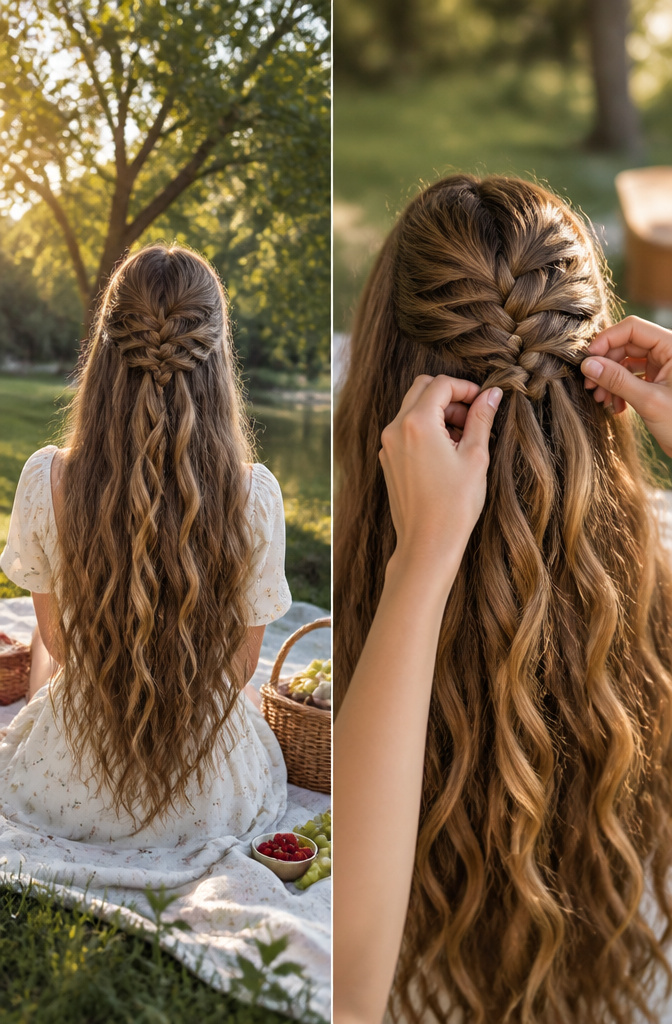
Long hair opens up styles you can commit to for weeks and ones you redo each morning.
Dreadlocks sit on the permanent end, a choice that reshapes how you wash, section, and maintain. French braids and pigtails fall on the temporary side, done with a brush and some patience. The half-up half-down style splits the difference, pulling the top layer back while the rest stays loose, a braid that only pretends to take all morning to arrange.
Some morning styles betray you by noon. A French braid can loosen at the nape from heat or the wrong elastic, leaving frizz where tension once held. Pigtails carry their own cut-off age, a style most of us quietly retired around twelve when they stopped reading as playful and started reading as stuck. The difference matters when you are choosing between something to sleep in and something to build before coffee.
Medium and Any-Length Styles

Styles that work across lengths or sit right in the middle give you the most mileage from a single cut. An updo or chignon ships your shoulder-length hair to a wedding in about twenty minutes, and braids do the same trick on Tuesday grocery runs. Extensions promise instant volume but the synthetic ones tangle into felt by month two, which is when I learned the $200 install was actually the cheaper half of the math. Highlights pleased me until the blonde in my brown lifted to the color of a traffic cone; toning every three weeks ate the savings of the "partial" price.
The mullet and bouffant cycle back every decade because they photograph well and because enough time passes that the bad versions are forgotten. The shag operates differently from the shag cut: one is a lived-in finish you can tease out of many layered styles, the other a specific 1970s blueprint with curtain bangs and heavy crown graduation. Asymmetrical haircuts read as editorial until your faster-growing side needs trimming every four weeks, and emo hairstyles, all angular fringe and guarded eyes, still surface in corners of punk and Gen Z revival spaces. Extensions that tangle, highlights that brass: the middle length bears those risks because it is the length most people attempt to change.
Styles by Occasion

Tuesday’s lived-in waves turn lazy; Saturday’s same waves read like you forgot the occasion existed. Effort scales with context, not with minutes in front of the mirror. The gap between what a celebrity posts and what their bathroom mirror actually showed involves a lighting team, a colorist on call, and the kind of clip-in placement that takes three hands, not two. I spent one anniversary dinner convinced I had copied a red-carpet updo exactly. The photo later proved the original had twice the volume and a pin I never saw; the wearer also never turned her head fast enough to need that pin to hold. Romantic braids and polished updos for longer hair work for dates precisely because they signal preparation without looking borrowed from someone else’s team. For special occasions, the same principle applies: cornrows, which could be done quickly and last over a week without tools or products, historically carried that same balance of practical preparation and deliberate meaning. The CROWN Act has now been enacted in 27 states and Washington, D.C., which matters when protective styles cross from practical choice to statement whether you intended one or not.
Men’s and Women’s Haircuts

The line between a men’s cut and a women’s cut blurs the moment texture enters the room. A cropped fade on straight hair reads barbershop standard, but the same clipper-guard fade on tight curls becomes something salons have been quietly claiming for years, and either shop can execute it well or badly depending on who holds the shears.
Watching my partner walk into a barbershop he’d used for a decade, then get directed to the "salon side" after growing his hair past four inches, clarified how arbitrary the divide remains. The price jumped twenty percent for the same fifteen-minute scissor pass. Salons charge more for perceived complexity that lives entirely in the label.
What actually differs: barbershops default to clipper work, heavier texturizing, and dry-cutting for shape; salons lean wet-cutting, layering around face shape, and finish with round-brush styling. A textured crop works from either chair if the person understands your hair’s density and growth pattern, not just which marketing photo you brought in.
For women wanting undercuts or sharp fades, barbershops often deliver cleaner results at lower cost, though the environment can feel unwelcoming. For men with longer hair wanting movement, salons offer technical layering barber training rarely covers. The right choice follows the technique, not the sign on the door.
Cultural and Textured Styles

Afros and cornrows carry meaning that runs deeper than their shape. During slavery, Black people often covered cornrows with scarves because the style was treated as somehow unpresentable, not "public hair." That same stigma later sent Black women home from workplaces while white wearers of the style were celebrated under names like "Bo Braids." The reclamation took decades of deliberate visibility: Essence put cornrows on its cover in 1972, Cicely Tyson on Jet a year later, and Beyoncé requested them for Vogue in 2018 — a first for that magazine. These moments matter because wearing a style without knowing its history is a choice with real weight, not a neutral fashion move.
Hair texture and density decide what a style actually looks like on your head, not the reference photo you brought in. An afro grown from natural African hair without straightening, combed regularly with a pick, will sit differently depending on whether your strands are fine or coarse, whether you have dense growth or sparser sections. I spent years frustrated that my hair would not hold the volume I saw on others before accepting that the same cut lives differently on different textures. The style is not failing; your hair is being itself, and the sooner you listen to what it does rather than punish it for what it will not, the closer you get to a version that actually works.
Hair Color and Processing

The lived-in color trend looks expensive on day one and still intentional at week eight, but the line between lived-in and neglected shows up around week five when the warmth in blondes turns brassy and brunettes take on a muddy flatness. I have watched friends skip toners to save money, then spend twice as much correcting the banding three months later.
Balayage holds its grow-out better than foil highlights because the placement mimics natural sunning, which matters if salon visits sit somewhere between haircut and utility bill in your budget. A full foil in a major city can cost what I used to pay for a studio apartment in 2012, and the six-week cycle turns into eight, then ten, then a root that needs a whole new strategy.
Box dye over-processed my ends so badly in college that the breakage created what one honest stylist called "a chemical haircut." The pigment lifted unevenly because I left it on five extra minutes chasing a shade the box picture promised and my porous mid-lengths could not deliver.
Virtual Tools and Professional Help

AI-powered virtual hairstylers now catalog over 14,000 celebrity and salon styles with 18 hair colors and highlight options, which sounds generous until you actually try one. The tools nail proportion and approximate color placement against your photo, but texture and movement stay flat on the screen. What grows out over six weeks never appears in the preview, and that matters more than the initial cut itself.
Consultations that factor in face shape, texture, and density do the corrective work the apps skip. A stylist can tell you where your natural wave pattern will fight a blunt line, or why fine hair needs layering at the crown to keep a bob from collapsing. The virtual version showed me a pixie that looked crisp and architectural; six weeks later the reality was all cowlicks and an awkward flip at the nape that the algorithm had no language for. The consultation I scheduled after that disaster cost the same as the app was free, and it saved me from repeating the mistake with a piecey fringe that would have read as thin against my density.
Use the apps to rule out extremes. Use a human to interpret what actually grows from your head.
Hair Care and Maintenance

A style falls flat if the hair underneath is fried, and a single season of bleach can outlast every cut you planned around it. The moisture barrier takes months to rebuild once it’s gone, which is why my routine now starts with a wet brush before anything else. Straight out of the shower, I work conditioner through with my fingers, then run the wet brush from ends to root to distribute it without snapping the strands that are already stressed. That one change dropped my breakage by half.
Heat styling every morning was the mistake that cost me. I told myself the protectant spray covered me, but 350°F day after day accumulates damage faster than any product can reverse. Now I air-dry until the roots feel dry to the touch, about fifteen minutes, and only then pick up the dryer on low. The style holds just as long and the ends stopped splitting by month six. For anyone counting washes per week, stretching to three with dry shampoo at the scalp buys the real recovery time the mid-lengths need.
Products, Tools, and Techniques
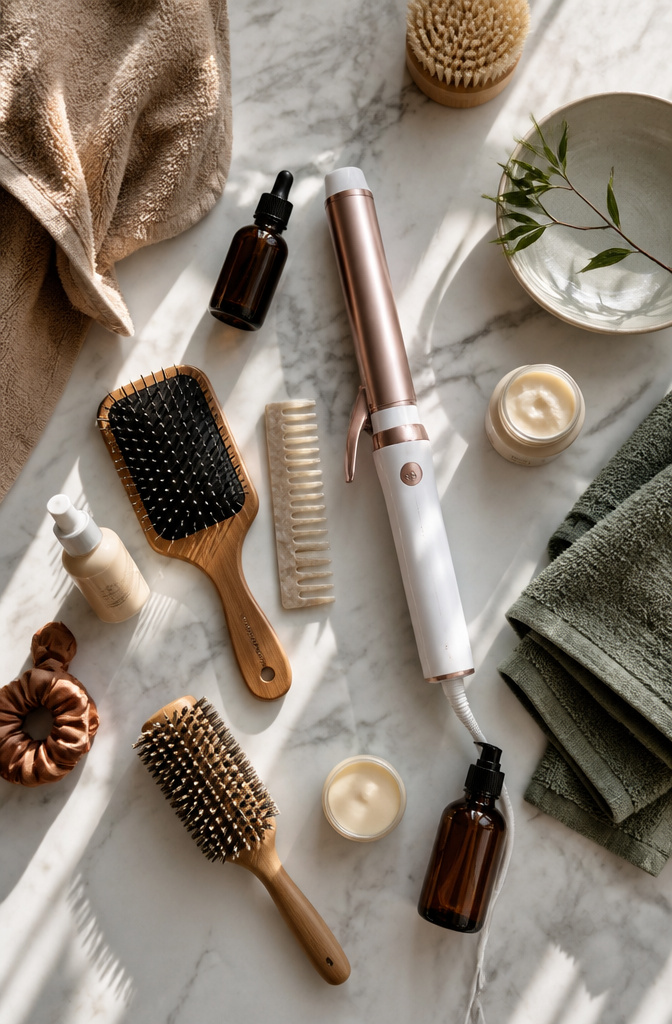
The difference between what a tool promises and what your hands can actually do usually decides whether something earns its drawer space.
A curling iron with five heat settings sounds generous until you realize your fine hair needs the lowest and your coarse sections need the highest, and switching mid-style burns a thumb. My first round brush had boar bristles that pulled so hard I lost patience before the blow-dry finished. The ceramic one that replaced it cost more but glides through without that tearing feeling at the crown.
Heat protectant sits on my counter. Mousse for volume and a lightweight cream for definition round out the working lineup. The texturizing spray, the glossing serum, the root-lifting powder: they alternate between the drawer and the trash depending on whether I remember to use them twice.
Technique matters more than the price tag. Sectioning hair before you run the iron through keeps the curl consistent from nape to front, otherwise the back goes flat while the face-framing pieces get overworked. The trick most videos skip is starting the curl away from the face on one side and toward it on the other; done without thinking, both sides sweep inward and look lopsided.
A paddle brush beats a vent one for detangling wet hair. Wet hair stretches and snaps, so patience costs less than repair masks. The Revlon one-step dryer brush had its moment online, and the results are real for the minutes it takes, but the motor hums loud enough that I reach for it less than expected.
Hair Trends Through Time

Styles that stick around tend to do something practical the decade forgot it needed. The ponytail never left because it keeps hair off your neck in summer and works at every length. The bob keeps coming back in new iterations because it frames the face without demanding morning time most people do not have.
Some returns are more selective. The 1970s shag is back in salons right now, layered and feathered around the face. The 1980s perm is not, and the difference matters for anyone saving reference photos from family albums. Perms relied on volume through chemical processing that damaged hair structure for a curl pattern most women now achieve with a $25 curling wand and ten minutes.
Some hairdos have been beloved ever since they arrived on the scene, while others are now relics of a different era. Still others have come and gone in several iterations, reconceptualized to fit the contemporary mood each time.
What this means for choosing now: a style that has already recycled at least once is likelier to age well in your photographs than one built on a single-era gimmick. The shag worked in 1974, 1994, and 2024 because the layers grow out forgivingly. The tightly wound perm worked once because it required upkeep no one warned you about. My own senior photo from 2003 sits in a drawer for exactly that reason: side-swept chunky highlights that read as trendy for exactly eighteen months, then as a timestamp. The shag in my college roommate’s photo from 1978? She wore a version of it again last year, and both moments hold up.
Age shifts the calculation, not the principle. Hair at twenty-five recovers from experiments hair at forty-four resists, but the question of whether a photograph becomes cringeworthy or merely dated stays the same. Cornrows carry generations of meaning and function; until the 2022 CROWN Act, they carried legal risk in workplaces and schools for Black women and men. That history makes them something different from a trend, and the distinction is worth keeping when you are choosing what sits on your head for years of photographs.
Hair Types and What They Need
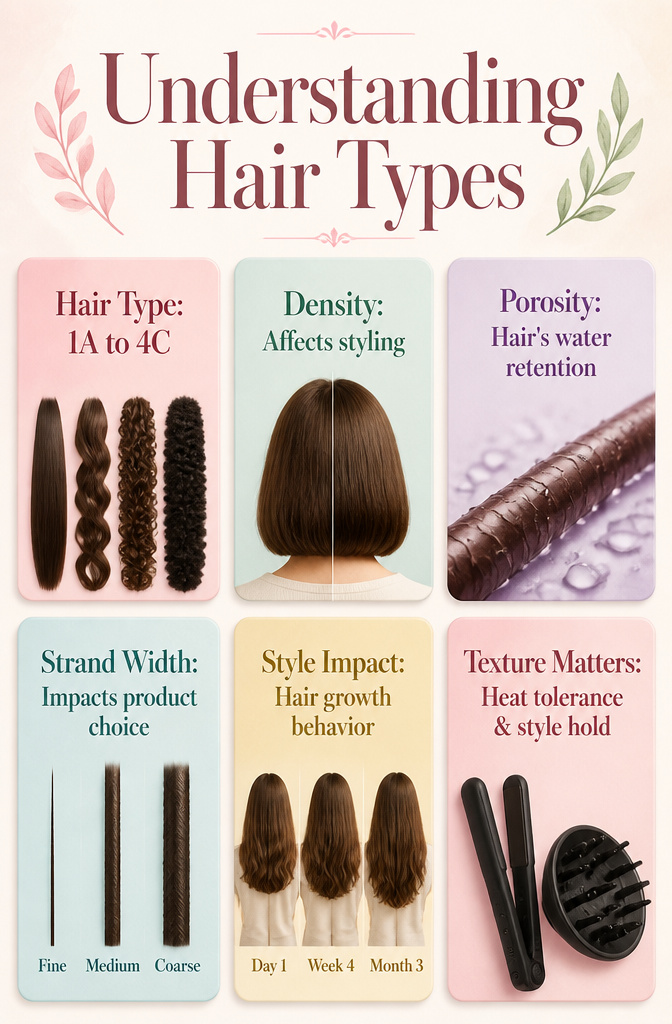
The standard hair typing system runs from 1A through 4C, and for years I filed myself wrong because I looked at my wet hair rather than how it dried. Density, porosity, and strand width matter just as much as that curl pattern number, which is why two people with 3B hair can need entirely opposite products.
Hair type tells you what a cut will do as it grows out. Fine, straight 1A hair tends to go limp with heavy layering, while tight 4C coils can lose their shape entirely if cut too blunt without internal texturizing. Length compounds this: the same density reads as thicker on a pixie than on waist-length hair because the weight is distributed differently. Texture matters for heat tolerance and how a style holds through humidity. What reads as "frizz" on one head is simply shrinkage doing its job on another.
I spent two seasons fighting a bob that my stylist loved because neither of us had clocked how much my hair densified after a health shift. The cut worked on paper, but daily styling turned into twenty extra minutes and a drawer of abandoned products. When the four factors align with the style, maintenance is manageable. When they do not, the best cut on Instagram becomes a morning argument with a flat iron.
Face Shapes and Style Matching

The six standard face shapes, oval, round, square, heart, diamond, and long, still show up in every salon consultation card and Pinterest guide. They matter less than the beauty industry pretends. A round face does not automatically need height at the crown; a square jaw does not require softening layers to look feminine. These categories persist because they give stylists and clients a shared vocabulary, not because geometry dictates what flatters.
I once sat in a chair with a stylist who measured my cheekbones against my jaw and declared me diamond-shaped. She gave me the recommended chin-length bob with volume at the temples. The cut was technically correct on paper. In practice, the width at my ears made my head look like a triangle whenever I tucked one side back, which I do constantly. I wore it in a ponytail for four months.
What actually matters is where your hairline sits, how dense your hair is at the crown, and whether you habitually push pieces behind your ears or let them hang forward. A heart-shaped face with a high, sparse hairline faces entirely different problems than one with a thick, low widow’s peak. The shape categories are a starting guess at best. Use them to begin the conversation with a stylist, then insist on testing the specific cut with your actual part, your actual density, and your actual daily habits before the scissors move.
Budget and Skill Reality

A decent salon cut in most cities runs somewhere between sixty and a hundred dollars now, though I have paid half that at training salons where supervised students work slowly and carefully. The drugstore option, using clippers or asking a friend, costs almost nothing but the margin for error is real; I once tried trimming my own layers and spent six months growing out stairs I could not blend.
DIY color boxed at maybe twelve dollars against two hundred at a salon is the gap that tempts most of us, and the difference shows most in lightening or correcting tone. I learned to do my own root touch-ups with semi-permanent in a shade close to my natural color because the risk of a line or wrong warmth was low. Anything involving bleach or going lighter by several levels, I stopped attempting after brass I could not fix at home.
Tools follow the same split. A hair dryer that lasts five years runs about a hundred and fifty dollars upfront, while the thirty-dollar version usually dies in eighteen months with a burnt smell. I bought one mid-range straightener in college, replaced it twice with cheaper pairs that lost their plates, and eventually went back to the brand that still works eight years later. The math only favors cheap if you replace rarely, and most of us style most days.
Accessories and Finishing

A thin browband, sometimes jeweled, can shift a blunt bob from office to evening without touching the cut. The 1920s called it the "headache band," which sounds like a warning but reads as chic against a low bun or cropped waves.
I bought a set of three snap clips from a drugstore checkout line in 2019, attracted by tortoiseshell patterning that matched my tone. The teeth grabbed too much hair, creating bumps where I wanted flat, and two of the three lost spring tension before summer ended. Stick to clips with flexible tension and a flat back if you are pinning sections for work; decorative fronts mean nothing if the clip slides or gouges.
Scarves and bands do what cuts cannot: they absorb oil at the root line on day three, buying another twelve hours before a wash. A narrow band worn across the forehead repositions a grown-out fringe. A wider scarf, folded and knotted at the nape, turns shoulder-length layers into something that reads deliberate rather than overdue.
The real cost of accessories is not the purchase price. It is the drawer of single successful uses: the crystal comb that worked once for a wedding and snags daily wear, the velvet band that collects dust because it presses a headache behind the ears after two hours. The headache band nickname was honestly earned.