

The right fix for thinning hair depends on whether the problem is fewer follicles, finer strands, or breakage shortening what’s already there. Each cause needs a different approach, and getting it wrong wastes months on rituals that never had a chance. The article below sorts this out with concrete thresholds: wet hair loses 30% of its strength, heat past 450°F causes permanent damage, and minoxidil’s gains disappear within months if you stop. Start with the condition that actually applies to you.
1. Avoid Brushing Hair When Wet

Wet hair loses roughly 30% of its strength, which is the part most people skip straight past in the shower mirror. I learned to notice the give: a strand that snaps before it stretches means the cuticle, those shingle-like cells shielding each hair, has already cracked under the pull. Breakage at that stage doesn’t regrow thicker; it just shortens the strand, and enough of it leaves hair looking thinner at the ends where density should show.
The fix is a wide-tooth comb used only after gentle towel-drying, never a brush. Start at the ends and work up so you’re not dragging tangles into a knot at the root. Sources vary on timing: straight hair handles air-drying first, then combing, while damp detangling works better for textured or curly hair. Either way, heat on very wet strands can bubble the shaft internally, so that cool-setting dryer stays in the drawer until hair is nearly dry.
2. Protein-Rich Treatments

Hair is roughly ninety percent keratin, a protein that gives strands their structure. Protein treatments work by depositing molecules that temporarily fill gaps along the cuticle layer, which smooths the surface and makes each strand feel thicker to the touch. Once every one to two weeks is the typical sweet spot; go more often and the accumulated coating can leave hair stiff and prone to snapping instead of soft and strong.
The simplest options are already in the kitchen. An egg mask uses the albumen and yolk’s amino acid profile to coat the shaft, though the smell is something you either tolerate or mask with a drop of essential oil. Full-fat yogurt brings lactic acid as well as protein, so it deposits and lightly clarifies in the same step. Commercial keratin treatments contain hydrolyzed proteins small enough to penetrate rather than just sit on top, and they skip the egg smell entirely. I reach for yogurt when I want something I can rinse out quickly; I buy the bottled kind when I need predictability and do not want to explain to a houseguest why the fridge smells like brunch.
3. Scalp Massage

Scalp massage was the first thing I tried when I started looking into how to naturally thicken hair, mostly because it costs nothing and carries basically no risk. The idea is that regular massage increases blood flow to the follicles, and a few small studies suggest four minutes daily might help hair grow in thicker. I press with my fingertips, not my nails, working in small circles across the whole scalp. Light to medium pressure feels right to me; anything harder just makes my head sore. Some people use a scalp massaging tool, but my hands work fine and I’m less likely to lose them in a drawer. Limit it to about four minutes a day, since that’s what the cited studies used, and going longer doesn’t seem to add benefit. Whether the growth claims hold up or not, the massage itself eases stress, and stress contributes to hair loss, so the time still earns its place.
4. Heat Styling Reduction and Protection

Heat lifts the hair cuticle and weakens the cortex from the inside out, and by the time your tool hits 450°F, the damage is permanent. That number is the hard ceiling for most hot tools, not a target to approach.
I used to assume the problem was solved by buying a better straightener. The sources convinced me otherwise: what matters is how often you reach for it, not what brand is in your hand. Skipping two or three heat days a week does more than switching to a pricier iron ever will.
When you do style hot, thermal protectant is the non-negotiable step. Celebrity stylist Michelle Cleveland puts it in terms of building a shield: humectants, amino acids, and keratin seal moisture and slow heat penetration so the shaft survives intact.
Air-drying to about 70–80% before you blow-dry cuts heat exposure substantially. Wet hair is super-stretchy and vulnerable; giving it that head start means the tool finishes the job rather than doing all of it.
5. Volumizing Products

Volumizing shampoo and conditioner build body by coating the outside of each strand rather than changing how fast or thick hair actually grows. The effect is real but temporary, and the difference between lightweight formulas and heavy ones is dramatic. A conditioner packed with silicones and butters flattens fine hair against the scalp, while a volumizing version lifts without the weight.
The question I see most often is whether fine hair can skip conditioner entirely. It can’t, not without paying for it later. Conditioner still smooths the cuticle, prevents breakage, and provides UV protection. The adjustment is placement: work it from mid-lengths to ends, keeping it away from the root where oil already accumulates. On wash days, blow-dry with your head flipped over and focus heat at the crown to set the lift that the product started.
6. The Right Haircut

Blunt ends reflect light evenly, which makes a strand band together and read as one solid mass. Wispy layers do the opposite: each feathered tip catches light separately, and fine hair turns transparent before it even reaches your shoulders.
I learned this backward. I walked into a salon asking for volume and walked out with ends thinned to the point of see-through. The cut felt lighter, which stylists often mistake for better, but the mirror showed less hair, not more. The illusion of density comes from weight at the perimeter, not air inside the shape.
One-length cuts, or cuts with only the slightest variation, keep that perimeter solid. If heaviness sits at the nape or drags the crown flat, a subtle undercut removes bulk from underneath without touching the visible line. Face-framing pieces work the same way: a few clean strokes at the jaw, but not over-layered, because layering around the face on fine hair usually means taking away the very strands that should read as thickness.
7. Scalp Health

A healthy scalp is where any attempt to thicken hair actually starts. The bulb of each shaft is alive, buried in the scalp, while the hair we style is already dead tissue. What bothered me, reading through how these things connect, was how much buildup from dry shampoo, texturizers, and hard water can smother that living base without showing obvious symptoms at first.
Product residue and mineral deposits sit on the scalp like a film, slowly blocking follicles and dulling new growth before it ever emerges. An occasional exfoliation clears that layer. A pre-shampoo scrub with gentle granules, or a salicylic acid treatment, lifts dead cells and styling buildup without the irritation of kitchen-cabinet oils. Olive oil in particular can feed yeast that triggers dandruff and inflammation, so that tip belongs back on Pinterest where it came from.
Scalp massage helps circulation, as mentioned earlier, but circulation is only one piece of scalp health. Keeping the environment clean, balanced, and free of inflammation matters just as much.
Some signs override home care. Persistent flaking, visible redness, or sudden shedding that clumps in the drain are signals to see a dermatologist. A ketoconazole dandruff shampoo can address yeast overgrowth and block DHT activity at the follicle, but prescribed treatment may be needed if the underlying issue is inflammatory or autoimmune. Knowing when to shift from home routine to medical opinion is itself a useful judgment.
8. Limit Damaging Styles

Traction alopecia still catches people off guard because the damage piles up quietly. Tight ponytails, braids, and extensions tug the same follicles day after day, and the hair loss is reversible only if you catch it early; keep the style up and the loss becomes permanent. The warning sign is simple: if your hairstyle is tight enough to cause a headache, it is tight enough to cause damage.
For sleep, silk or satin pillowcases cut the friction that breaks strands overnight. The sources do not specify exact fabric weights or thread counts, so pick what feels smooth against your skin. During the day, looser fastening methods help: twist ties that do not cinch, claws that hold without dragging, or scrunchies that spread pressure across more hair rather than concentrating it at one point.
This sits next to heat reduction in most hair guides, but the problem here is mechanical, not thermal. A cool tool does not save you from a pulled root. Treat these as separate checks: one for temperature, one for tension.
9. Thickening Treatments and Extensions

Topical minoxidil at 5% remains the only over-the-counter option with enough backing to call it a standard. It prolongs the active growth phase of each follicle and, over time, can convert those wispy vellus hairs back into the thicker terminal strands that actually fill out a ponytail. The catch is patience: visible density takes four to six months, and some people see increased shedding in the first few weeks as weaker hairs make way for stronger ones. Stopping means losing whatever grew, so the commitment is ongoing, not a one-time fix.
For instant gratification, extensions divide cleanly into two camps. Clip-ins go in and come out daily, so they add bulk without tugging at the root. Semi-permanent methods / tape-ins, sew-ins, bonded strands / sit tight for weeks and can stress follicles past recovery if your hair is already fine.
A dermatologist can offer platelet-rich plasma injections or microneedling, though neither carries the consistency minoxidil does.
Microneedling is complicated and can even make some conditions worse.
That risk alone is reason enough to seek professional guidance rather than buying a home roller and hoping for the best.
10. Diet: Zinc, Iron, and Protein

The hair above your scalp is already dead. Every strand is keratin pushed out by living follicles, and those follicles burn through protein to keep the assembly line running. Skimp on protein intake, and the follicle downshifts. I learned this the hard way after switching to a mostly-vegetable diet and watching my ponytail shrink over a summer. The fix was simpler than any serum: eggs, fish, lentils, getting back to enough protein that my body didn’t have to ration it away from hair.
Iron deficiency shows up first in women who menstruate, and it is both common and testable. A doctor can check ferritin levels in minutes. Low iron means less oxygen reaches the follicle, and the follicle responds by shedding. But do not supplement iron without that blood test first. Too much iron builds to toxicity, and the same holds for zinc. The mineral supports follicle function, but the path to better hair runs through a lab slip, not a bottle from the supplement aisle.
Hair changes lag behind dietary fixes by about two to three months. The strand you see today started forming in a follicle fed by last season’s nutrients. Start eating for thickness now, and the difference shows up in the mirror later than patience expects.
What Makes Hair Look Thin
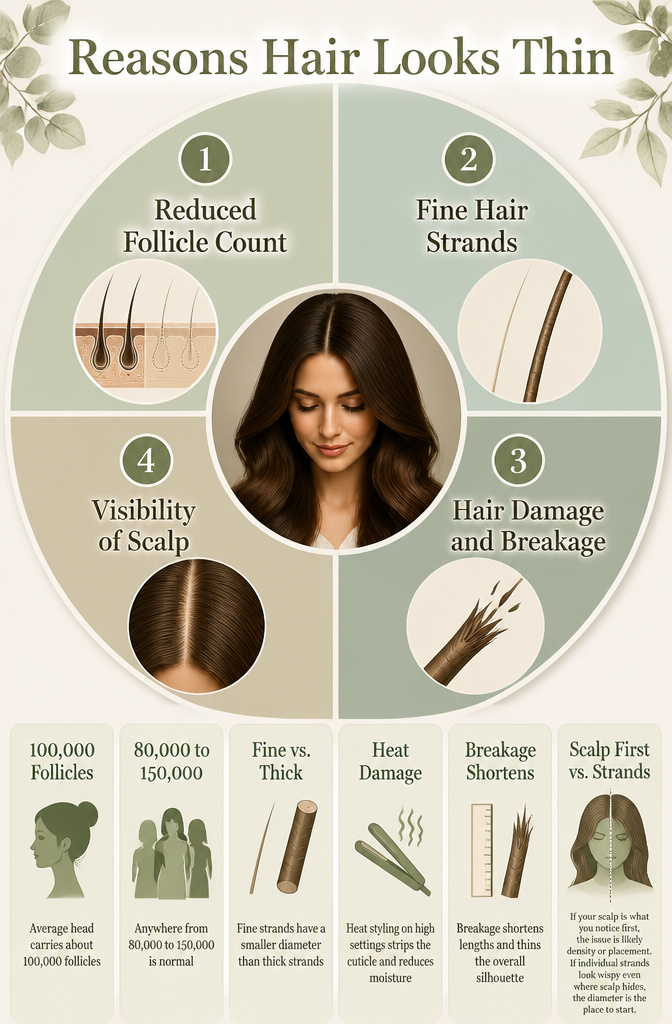
Hair reads as thin for four separate reasons, and knowing which one applies changes what you actually do about it.
Some scalps simply have fewer active follicles. The average head carries about 100,000 follicles, though anywhere from 80,000 to 150,000 is normal. When that count drops, scalp shows through no matter how healthy the strands themselves are.
Others are born with fine strands, meaning each hair has a smaller diameter, like silk thread against cotton. Fine hair can still look full if there’s enough of it, but the two conditions stack: fine plus fewer follicles equals visible scalp faster.
Damage creates a third category. Breakage shortens lengths and thins the overall silhouette without the follicle count changing at all. Heat styling on high settings strips the cuticle and reduces moisture, which leads to exactly this kind of structural loss.
The fourth is visibility itself. Any combination of the above, or even just how hair is parted, can expose more scalp than the style intends. If your scalp is what you notice first, the issue is likely density or placement. If individual strands look wispy even where scalp hides, the diameter is the place to start.
Washing Frequency for Fuller Hair

Overwashing gets all the blame for fine hair, but oil buildup is the quieter problem. Sebum climbs down the shaft, dust sticks to it, and roots flatten against the scalp so thoroughly that even a good volumizing shampoo can’t lift them. For most fine-haired people, every one to two days with a lightweight, sulfate-free volumizing formula keeps that film from setting in. Stretching to a week, or relying on co-washing, leaves enough residue that strands clump together and look thinner than they are.
The choice of product matters as much as the schedule. Sulfate-free shampoos labeled "thickening" or "densifying" with protein, panthenol, or biotin coat and swell each strand for fuller-looking hair without stripping the oils that keep it flexible. Dry shampoo can buy a day between washes, but relying on it too often leaves its own residue on the scalp. Skipping the wash altogether weighs hair down more than a daily rinse with the right formula would.
When Thinning Signals Something Else

Sudden shedding that clogs the drain or patchy spots where the scalp shows through are not the same as gradual thinning from styling damage. Those patterns usually mean something internal is shifting, and the at-home fixes this article covers will not touch them. Thyroid disorders, iron-deficiency anemia, the hormone crash after birth or during perimenopause, and autoimmune conditions like alopecia areata all present this way. A board-certified dermatologist is trained to spot the difference and can order bloodwork or a scalp biopsy to find the actual trigger.
I waited six months on scalp rituals and keratin masks before making that appointment, which was four months too long. The dermatologist I finally saw said the clumps in my brush had been signaling a straightforward iron deficiency that routine bloodwork would have caught in August instead of December. Minoxidil came up in that visit too, but only after the lab results were back. The over-the-counter formulas flagged most often, Women’s Rogaine 5% Foam and similar, are still a conversation to have with a doctor first, not a substitute for figuring out why the hair is leaving to begin with. If the change in your hair feels faster than the timeline of a bad haircut, schedule the visit now.
What Minoxidil Actually Does

I reached for minoxidil about six years ago when my part started looking wider than it used to, but the twice-daily rhythm was harder to keep than I expected. The 5% foam was simpler to work into my morning routine, whereas the 2% liquid felt like a second job that kept slipping.
The mechanism itself is fairly straightforward: minoxidil opens potassium channels, which extends the anagen phase of your hair cycle, so active growth lasts longer before strands shed. It can also push vellus hairs toward terminal thickness, which is where the visible fullness comes from.
What stopped me wasn’t the schedule; it was understanding that stopping use means losing results within months. The gains aren’t yours to keep, they belong to the routine. That changed how I thought about committing, and it should change how you budget the decision too.
Styling Techniques That Add Body

Root-lifting clips changed how my blow-dry looks, even on second-day hair. The trick is placing them where the crown lifts and leaving them in while the roots cool against the airflow. That tension against the natural growth pattern is what keeps the height from flattening by noon.
Directional blow-drying works the same principle deliberately. You sweep strands opposite to how they fall, which forces the base upright. A round brush helps for hold, though honestly fingers work if your arms can take it.
Velcro rollers for a cool-set build body without reintroducing damage. Wrap them in toward the back while hair is still warm, then do your makeup or coffee before pulling them out. The set stays longer than hot tools alone because the hair-shaft shape locks in at a lower temperature.
Backcombing still has a place, but the surface has to be a buffer. A comb with wide-set teeth eases the outer layer back over the teased section, so the mechanical stress sits underneath where it is hidden. Do not repeat the same patch more than once between washes; repeated compression at identical points is where the breakage starts. Cool-set before texture work, and the height holds without the cotton-candy look.
Frequently Asked Questions
What causes hair to look thin or flat?
Four things: fewer active follicles, finer individual strands, damage from heat or breakage, and how the hair is styled or parted. Health conditions like thyroid disorders or iron deficiency can also trigger sudden shedding that looks like thinning. If the change is rapid or patchy, a dermatologist visit is the right move.
Can shampoo and conditioner really make my hair look thicker?
Yes, but the effect is cosmetic and temporary. Volumizing formulas coat each strand to build body, while lightweight versions lift without weighing hair down. Heavy conditioners with silicones or butters flatten fine hair, so placement matters: work conditioner from mid-lengths to ends, keeping it off the root.
How often should I wash my hair to make it look fuller?
Every one to two days with a lightweight, sulfate-free volumizing formula. Oil buildup flattens roots and clumps strands together, making hair look thinner than it is. Stretching washes too long, or relying heavily on dry shampoo, leaves residue that weighs hair down.
Should I avoid conditioner if I want thicker-looking hair?
No. Conditioner smooths the cuticle, prevents breakage, and provides UV protection. Fine hair still needs it; the adjustment is where you put it. Keep conditioner away from the scalp and focus on mid-lengths to ends, where the strand needs the moisture without the weight at the root.
Will cutting my hair help it look thicker?
Yes, if the cut is blunt rather than layered. One-length cuts keep the perimeter solid so light reflects evenly and strands read as one mass. Wispy layers do the opposite: each feathered tip catches light separately, and fine hair turns transparent before it reaches your shoulders.