A colorful outfit that actually feels finished takes about twenty minutes to plan and three to four accessories to execute, but most people stop at one bold garment and wonder why the look still reads flat. The failure happens earlier than they think, at the moment they treat the bright coat or printed blouse as the whole statement instead of the starting point. Starting with a single center of gravity, like a cobalt coat against all black, only works if you build outward from it with intention rather than adding whatever is closest to hand.
1. Start with One Colorful Piece

A cobalt coat against all black? That single piece does the work so nothing else has to shout. The same rule holds for rust trousers, a moss green scarf, anything that answers the question of how to add color to an outfit without letting things slide into competition. Four separate style guides agreed on the same fix: start with one bold item and build around it.
The piece you pick should already know your closet. A bright orange skirt bought for someday stays on its hanger; a sweater that feeds straight into your usual jeans rotation gets worn. The rest of the outfit stays relatively understated so the brighter item has room without another color elbowing in. One visually interesting piece is enough to carry the look.
Keeping the orbit simple is what keeps the result readable. Neutral accessories can ground the outfit later, but the first move is committing to that single center of gravity.
2. Let Patterns Supply the Color

Printed fabrics carry more than one hue inside a single piece, which makes them an easy starting point for color that does not need inventing from scratch. A floral blouse with small flecks of blue tucked into its pattern gives you a specific shade to repeat elsewhere, sapphire earrings picking up that exact tone so the choice reads deliberate rather than matched by accident. Stripes and checks work the same way, the multiple shades already resolved into a kind of built-in palette. Pull one shade from the pattern and repeat it in an accessory; the rest of the outfit stays neutral so the printed piece keeps doing the visual work. With tie-dye, florals, or abstract prints, the same rule holds plain denim or white keeps the bright piece centered without competition.
3. Find Colors That Work With Your Wardrobe

A new accessory earns its place when it ties back to something already hanging in the closet. Pick one or two colors from a piece you wear often and repeat them in the strap, bead, or buckle. Turquoise sandals that echo a turquoise top pull the look together without introducing a third or fourth hue that fights for attention.
Pull everything out and sort by color. One glance at the piles shows where a belt or scarf would bridge gaps: a rust bag that picks up threads from two different shirts, or a necklace carrying both the pink from a floral dress and the navy from a jacket. The goal is an outfit you can repeat next week, not a single styled moment that required a shopping trip.
If the wardrobe leans heavily on one color family, accessories in a tonal shift do the same work. A darker shoe with a lighter dress, or a muted sage belt with a brighter green blouse, keeps the harmony without needing an exact match. The audit itself takes twenty minutes and saves the mistake of buying a stand-alone piece that never finds company.
4. Use Neutral Accessories to Ground the Look

Bright color needs something to push against, or it just floats. A vivid red dress against bare skin and more vivid red reads loud but unfinished; the eye has no place to rest. That is where neutrals earn their place, not as a retreat from color but as a deliberate pause that lets the bright piece actually register.
Tan, black, white, and metallics all do this work, but the choice matters. Black against a saturated pink or cobalt gives you sharp contrast, almost editorial. White or cream keeps the same brightness level but feels lighter, more daytime. Navy fills the same slot with less drama than black if the occasion calls for it. Warm tortoiseshell against cool brights, like emerald or electric blue, reads collected rather than cautious; the temperature difference between the accessory and the garment looks intentional because you had to notice it to choose it.
Metal sits apart: a thin chain or small hoop in silver or gold catches light without adding another hue to manage. It functions the way denim does, almost as a neutral itself against a wide range of colors.
The mistake is treating neutral as automatic or safe. A black pump with a bright dress is fine, but the same black pump with a black bag and black earrings starts to look like you got scared of what you put on. Pick your neutral, then stop. Let the color do the rest.
5. Add Smaller Pops of Color Through Accessories

Accessories do the work of a bright shirt without the commitment. A colorful bag can change the feel of an otherwise neutral outfit, which makes it the safest first move if you are not used to wearing color close to your face. A structured tote or a slouchy crossbody in a bold hue like orange, cobalt, or mustard can add personality without demanding a whole new wardrobe.
The same logic applies to shoes, belts, and jewelry. Each one is a contained dose you can remove or swap out. A bright sneaker or an unexpected belt keeps the experiment reversible. Scarves work this way too, though they sit closer to your face than a bag does, so the shade matters more against your skin.
What trips people up is treating every accessory as its own statement. One or two colorful details are usually easier to coordinate than three or four competing for attention. Repeating the same color across accessories keeps the look intentional, and shades that sit comfortably together read as planned rather than accidental. Socks count here too; a flash of color at the ankle reads as playful, not loud, because the scale stays small. The smaller the item, the braver the color can be.
6. Experiment With Different Shades of the Same Color

A teal bag carried against an emerald dress reads as considered, not accidental, because the two share a blue-green root rather than matching by accident or starkly clashing. The eye picks up the relationship and treats it as intentional.
Tonal dressing works the same way in accessories as it does in clothes. Pale blue gains structure from navy, soft pink gains depth from burgundy, and sage green gains anchor from a forest shade. The colors do not need to match perfectly. Slight differences in tone usually make the combination more interesting than a flat, single-color wash.
Texture separates similar shades so they do not read as repetitive. A knit, a leather, a linen, and a polished metal all reflect color differently, which means three items in related greens can live in the same outfit without looking like a uniform.
When to layer and when to stop? Judge by whether you can name the color family in one word. Teal and emerald both answer to "blue-green." Soft pink and burgundy both answer to "red." If you need two words and a shrug, the shades are too far apart and the look tips from tonal into accidental. Add a neutral piece, a cream trouser or a tan shoe, to create distance and let the color story breathe.
7. Choose One Focal Accessory

A single clear focal piece usually reads better than several competing elements. That sentence sounds obvious until you catch yourself in the mirror wearing bright earrings, a printed scarf, and a statement bag all at once. I have done it. The eye bounces around and lands nowhere.
Start with just one focal point. Stylists call it a hero piece: the bold earring, the unique belt, the vibrant shoe that grabs attention and sets the tone for everything else. The decision is simpler than it feels. Pick the item with the most personality, or the one that speaks to a color already in your outfit.
If your hero piece is big and bold, keep supporting pieces more delicate and understated. The balance keeps the look intentional rather than cluttered.
Your confidence is the best accessory, but confidence reads louder when it has a clear center of gravity.
8. Balance Scale and Proportion

Small accessories against bulky clothes create a visual sinkhole no amount of color can fix. That whisper-thin gold chain you love slips under a chunky knit and disappears. The sweater wins by default, but not in a way that looks intentional.
The same mismatch works in reverse. A pair of oversized earrings planted right next to a high neckline fights the collar line instead of finishing it. Both pieces demand the same eye-level territory, and the clash reads as accidental.
Heavier fabrics like wool, denim, and leather hold their own against chunkier, more substantial jewelry. Lightweight silk or linen pairs better with delicate pieces that echo their airiness rather than dragging them down.
The volume rule is simple: one lead piece, everything else quieter. A statement necklace wants simple studs or bare ears. Stack rings for texture, but if the sleeves are already doing volume, the wrist stays clean.
Body frame matters too. An oversized tote on a petite frame throws the whole silhouette off center, not because the bag is wrong on its own, but because the scale relationship is wrong.
Accessories should sit in support, not demand a separate conversation.
9. Relate Colors and Shapes to the Outfit

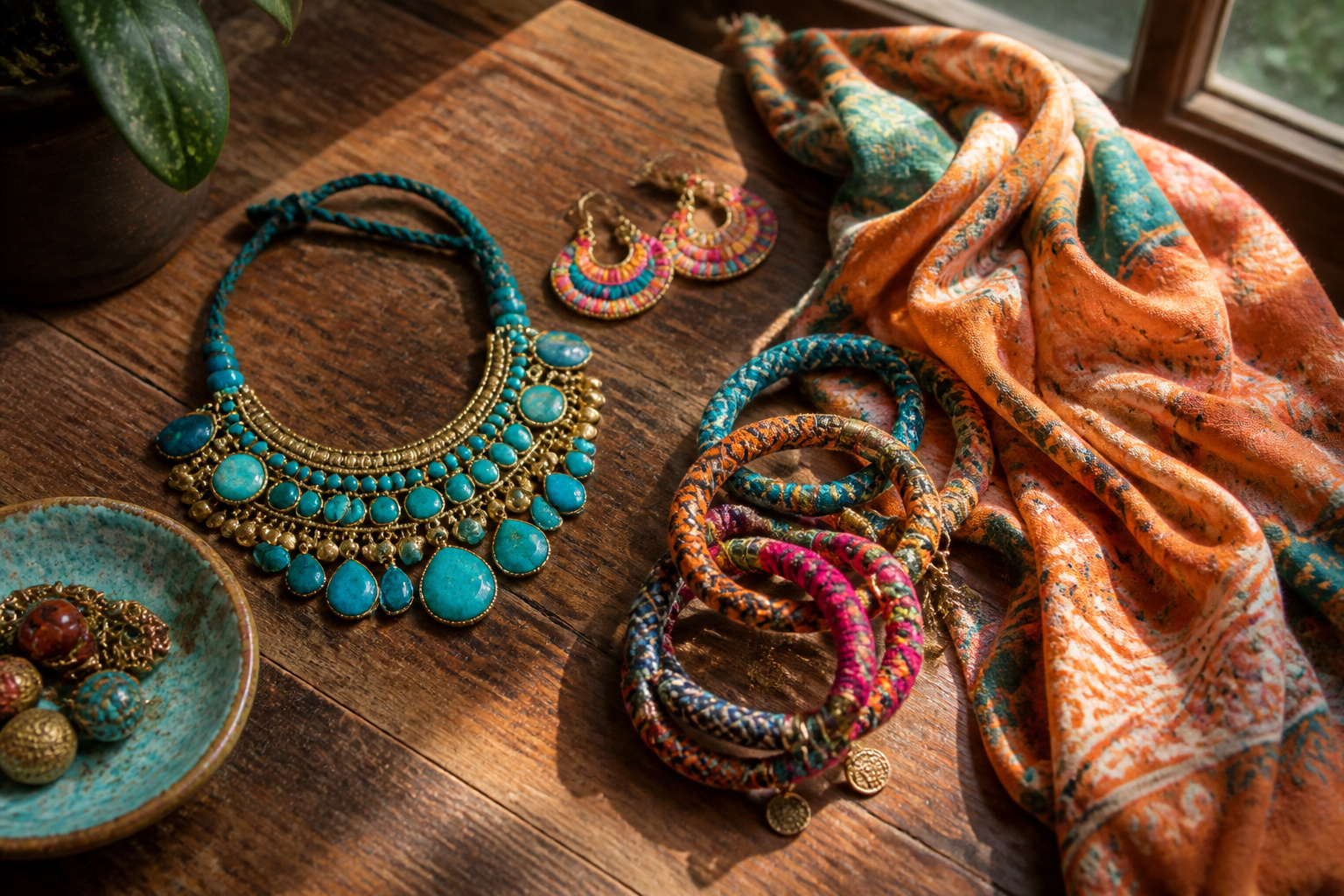
A gathered leather clutch and a curved sandal heel share the same arc, and the eye registers the match before the brain names it. That little collision of shape is what makes accessories feel chosen, not grabbed. Heavy boots on the bottom ask for structure up top; a defined earring or a necklace with some architecture restores the balance. The same logic runs through color: repeating a button’s warm gold in a belt buckle, or pulling the turquoise from a print into a single bangle, ties the whole look together without adding new colors to manage. Florals in the fabric get along with curvy jewelry; checks and sharp angles want cleaner, simpler lines. A mask cut from the same fabric as the skirt works because the shape echoes are obvious, even if nobody notices consciously. Two tones repeated across three pieces is usually enough: more starts to look accidental, less looks like you forgot to finish. The outfit moves from assembled to finished when every accessory seems to be answering something the clothes already said.
10. Give Yourself Time to Adjust

A bright outfit feels louder the first few times simply because it is unfamiliar, especially after years of dressing in neutrals. What helps is giving yourself a window to acclimate before you judge the combination. I usually wear a new color pairing at home first, or on a low-stakes weekend where comfort already settles me in. Photographing the look is the other half of this: seeing it on my phone screen adds distance I cannot fake in a mirror, and over a few weeks those photos reveal which shades I actually reach for versus the ones I talked myself into. Start with one or two colorful accessories on a familiar base rather than rebuilding the whole silhouette; the lower the commitment, the more honest your reaction. If the green scarf feels right with three different outfits, the green cardigan probably will too.
Why Accessories Complete the Look

A colorful outfit without accessories sits at the same energy level as a sentence without punctuation: technically complete, but the intention never fully lands. The clothing starts the statement, and that is where most people stop. Accessories are what turn a color choice into a point of view.
The mistake is treating them as optional, something to add only when an outfit feels flat. Sources agree they are structural. A structured necklace or defined earrings do not decorate; they restore equilibrium when heavy boots or strong shoes pull the eye downward. Multiple necklaces mean simpler wrist and hand jewelry, because balance is not the same as abundance. Accessories that echo garment hues or introduce subtle contrast read as intentional rather than accidental. Each piece should support the outfit, not fight it.
This matters most at moments that already carry pressure. For weddings, galas, or formal parties, the impulse is to pile on the drama, but the actual move is restraint: pick one area and make a statement. Shoulder-dusting earrings become the star when the necklace disappears; an intricate neckline needs only a cocktail ring and clutch. Overdoing it is the common failure, and it is always visible.
The point of the ten steps that follow is not to accumulate more. It is to choose with enough precision that the color story you started actually finishes where you meant it to.
Color Coordination Rules That Hold Up

Warm colors lean red, yellow, or orange; cool colors lean blue, green, or purple. Matching accessories to an outfit works best when you know which side your base color falls on, because a warm coral dress goes muddy with a cool silver shoe and comes alive with a warm gold one. That distinction matters more than the old rule about matching metals at all.
The real question readers ask: can I mix different colors in my accessories? Yes, but they need to talk to each other and to the outfit. One approach is tonal dressing, pairing different versions of the same color, like pale blue with navy. The colors are related, so the look holds together even when several pieces are bright. Another approach is adding a third color through accessories themselves: a cobalt jacket over black, then orange earrings that pick up a shade in a printed scarf. The accessories complement each other rather than each shouting its own color.
Breaking rules works when you do it intentionally. Mixing gold and silver is dated advice; a two-toned watch or bracelet bridges both metals cleanly. Texture helps too. A smooth leather bag against a fuzzy wool coat adds interest without adding another competing hue. The mistake is forcing contrast for its own sake. A vivid outfit with busy prints already has enough to say. Accessories should respond to what the garment needs, not compete for attention.
How Many Accessories Are Too Many

The sweet spot for a colorful outfit is three to four key accessories, which is where a look starts to feel intentional rather than thrown together. Anything less reads as unfinished; anything more risks the cluttered effect Coco Chanel warned against when she advised removing one item before leaving the house.
How you count matters. A single necklace counts as one accessory. Stack three thin rings on the same finger, though, and that still reads as one unit because the eye processes them together. The same goes for layered chains of similar weight or a cluster of small stud earrings in multiple piercings. What balloons the number is placing competing statements at different heights, a bulky scarf, a crossbody bag, and oversized earrings all demanding attention from the same column of space.
Scale keeps the count honest. A structured tote or wide belt carries more visual weight than a delicate chain, so it eats up more of that three-to-four allowance. Pair that tote with a statement necklace and you are already at capacity; stud earrings and a single ring finish the math without tipping into costume territory. Fabric weight matters too. Chunky jewelry belongs with wool, denim, and leather, airy silk and linen ask for lighter pieces that keep the proportion intact. Mixing the two is where an outfit starts to look accidental rather than edited.
Layering Techniques That Add Without Clutter

Layering accessories only works if the pieces talk to each other rather than compete. Start from one focal point: a bold earring, a wide belt, a pendant that falls where your neckline opens. Everything else builds from there, and restraint around that second or third layer is what keeps the whole outfit from reading cluttered. Earrings frame the face in conversation, so if a pendant sits at your collarbone, drop the competing statement at the ear and let a smaller stud hold the space. When bracelets stack, stacked rings become the quieter choice, and vice versa.
Mixing metals reads modern when it is deliberate, not accidental. A two-toned watch or bracelet acts as a bridge between silver and gold so the mix looks considered rather than like you grabbed whatever was close. The old rule against combining them is outdated, but the confidence part matters: a single bridge piece signals intent in a way three random metals do not.
Texture layers the same way texture mixes in fabric. Smooth leather against beaded surfaces, or polished metal against something matte, adds depth without shouting. If your sleeves are voluminous or ornate, minimal wrist and hand jewelry usually works better. Clothing and jewelry support each other; when the garment already carries weight, the accessories should step back. That restraint is what lets a standout piece shine, and it is the difference between layered and overdone.
Frequently Asked Questions
How do I add color to my outfit?
Start with one bold piece and keep everything else understated. A cobalt coat over all black, rust trousers with a neutral top, or a moss green scarf with your usual jeans gives the bright item room without competition. The piece should already fit your rotation, not hang waiting for someday.
What accessories should I use to complete a colorful outfit?
Use accessories that either echo a color already in your clothes or add one deliberate pop. A structured tote or crossbody in orange, cobalt, or mustard changes the feel of a neutral base; repeating that same color across a belt or shoes keeps the look intentional rather than scattered.
How many accessories are too many?
Aim for three to four key accessories. A single necklace counts as one; three thin rings on one finger still read as one unit. A bulky scarf, crossbody bag, and oversized earrings all demanding the same vertical space is where the look tips into clutter.
How do I choose a focal accessory?
Pick the item with the most personality, or the one that speaks to a color already in your outfit. A chunky sculptural necklace against a simple dress, a vibrant bag with jeans and a tee, or a bold belt cinching a blazer all work as the anchor. If the hero piece is big, keep everything else delicate.
Can I mix different colors in my accessories?
Yes, but they need to relate to each other and to the outfit. One approach is tonal: pair pale blue with navy, or soft pink with burgundy. Another is a third color through accessories themselves, like orange earrings picking up a shade in a printed scarf. The accessories should complement each other rather than each shouting its own hue.