
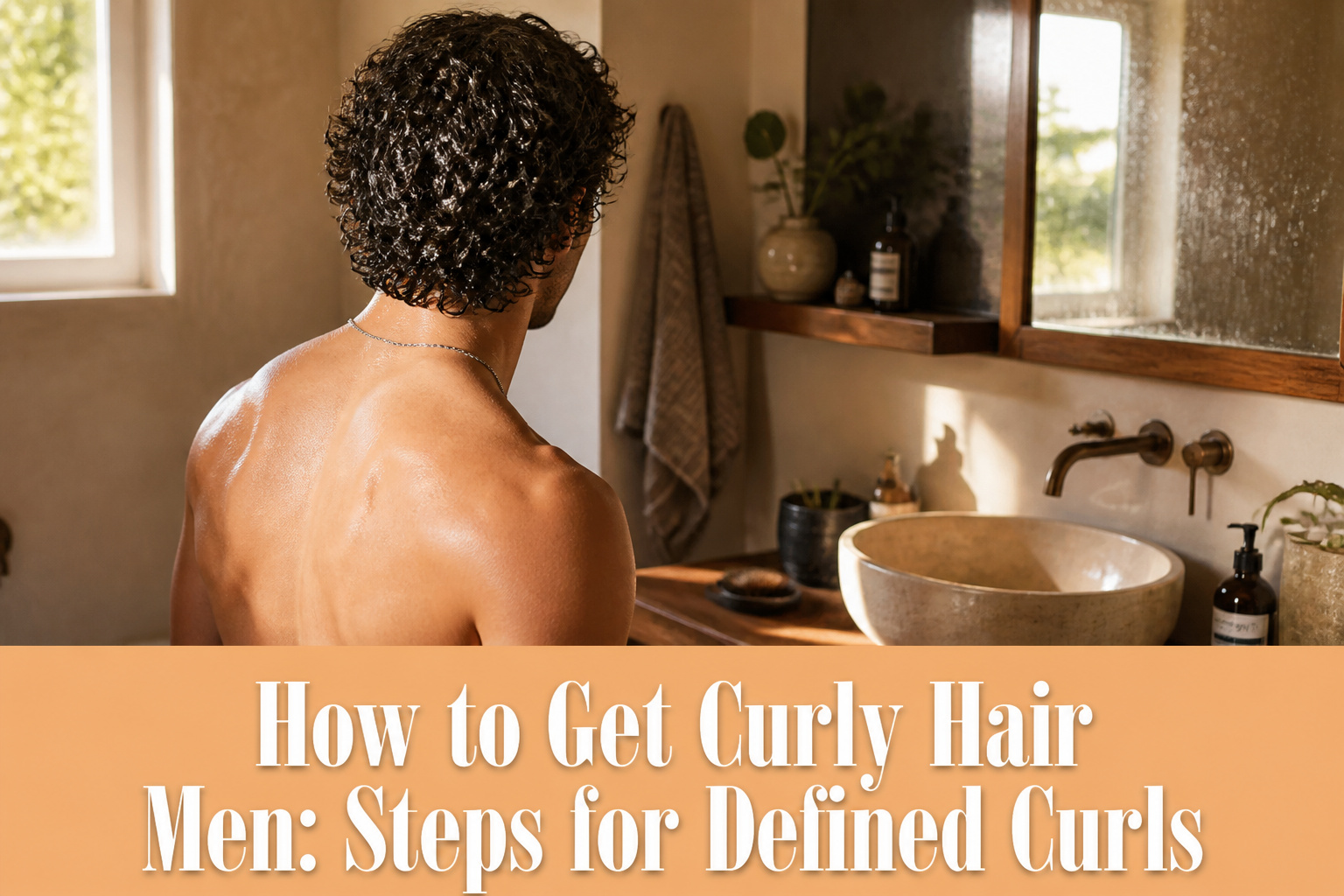
Defined curls that hold from morning until night take about twenty minutes after a shower, plus a satin cap or pillowcase you can buy for under fifteen dollars. Most men get the sequence wrong: they reach for gel before any leave-in conditioner touches their hair, which is the same as sealing moisture out instead of in. The fix is one pump of leave-in per side, worked through soaking-wet hair before anything else, because styling products lock that base layer in, not the other way around.
1. Understand Your Natural Curls

Wavy, curly, and coily hair each ask for something different, and the curl typing system breaks this down simply. Types 2, 3, and 4 indicate your pattern: 2 covers waves, 3 covers curls, and 4 covers coils. The letters A through C refine how tight the pattern gets, so a 3B head of hair has looser ringlets than 3C.
Get this wrong and you will misread every product and technique that follows. Someone with Type 2 waves using coily-hair creams loses definition and battles grease by noon. A Type 4 guy borrowing lightweight mousse from a wavy friend gets shrinkage and dryness instead of stretched, shaped coils.
Check your hair in good light, ideally when it is air-dried without product. Waves show an S-shape and sit flatter at the root; curls form distinct ringlets; coils make a Z-shape or tight corkscrew and pack volume you notice immediately. Mixed patterns happen, so focus on the dominant texture where your hair grows thickest. That reading drives whether you need lightweight layering or dense moisture to get the definition you are after.
2. Choose the Right Cleansing Products

Shampoo strips natural oils from curly hair much more aggressively than most men realize, and the daily lather habit most of us picked up in middle school turns out to be one of the fastest ways to flatten a curl pattern before it ever forms. Cutting back to 1 to 2 washes per week lets the scalp’s own sebum travel down the shaft and keep coils from drying into frizz.
The bottle matters as much as the schedule. Sulfates, the same foaming agents that make drugstore shampoo feel so satisfying, scrub away so thoroughly that they loosen the cuticle layer and leave hair porous enough to lose moisture the same day. Parabens and silicones present a different problem: they accumulate on the strand, weighing down the natural spring that gives curls their shape and eventually creating a coating that conditioner cannot penetrate. A "final wash" with a clarifying formula makes sense once, at the very start, to strip that residue off completely. After that, a sulfate-free shampoo alternated with co-washing (using conditioner alone) keeps the balance without the buildup. On days when the scalp feels oily between washes, water and a gentle scalp massage do more good than another round of detergent.
3. Nourish Your Curls with Conditioners

The wrong conditioner weight does more damage than you think. I learned that watching a roommate with fine, wavy hair borrow my coily-hair routine: his waves went stringy and flat by noon, while the same product on my head felt like it had barely shown up.
Lightweight conditioners work for wavy or fine strands because they hydrate without collapsing the delicate S-shape pattern. Heavy formulas like those built around shea butter or safflower seed oil sit on top instead of absorbing, and the extra weight pulls the wave out before you leave the house.
Coily and tightly textured hair lives at the opposite end. The Z-shaped or corkscrew strands are naturally more porous, which means moisture exits faster than it enters. A heavy conditioner penetrates that structure and stays, giving coils the saturation they need to hold definition between wash days.
Medium conditioners split the difference for true curly types, the ones forming distinct ringlets. Too light and the frizz shows by afternoon; too heavy and the bounce goes flat.
The test is texture, not marketing. Flip the bottle: oils and butters listed high signal weight; water and light esters near the top mean it is built for finer hair. Apply to soaking-wet hair, work from ends upward, and if your curl pattern still looks deflated within two hours, the weight is probably wrong.
4. Enhance Moisture and Definition with Leave-Ins
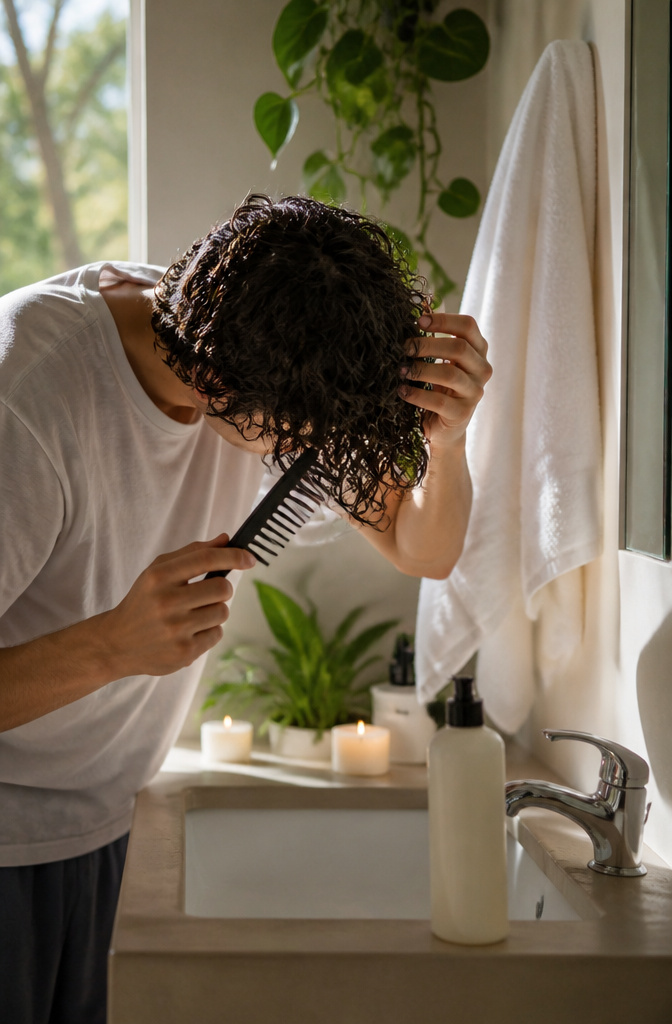
Leave-in conditioner is the step most men skip and then wonder why their curls fell flat by noon. Applied to wet hair, before any gel or cream, it acts as the moisture anchor that keeps the curl shape from drying into a fuzzy outline.
The amount matters more than the brand. One pump for each half of the head, worked from roots to ends with fingers or a comb, is the proportion that actually distributes through hair instead of sitting on top. A comb helps spread it further, especially if the hair is long enough to tangle. Apply it before anything else: styling products seal the leave-in in, not the other way around.
Some formulas double as curl definers, others are purely moisture. If the hair is already holding a decent pattern from the shower, a lightweight milk is enough. If it tends to poof, something richer saves you from needing twice as much gel later. The hair should feel damp, not dripping, when you move on to the next product; four hours of air drying is typical from that point.
5. Deep Condition Weekly
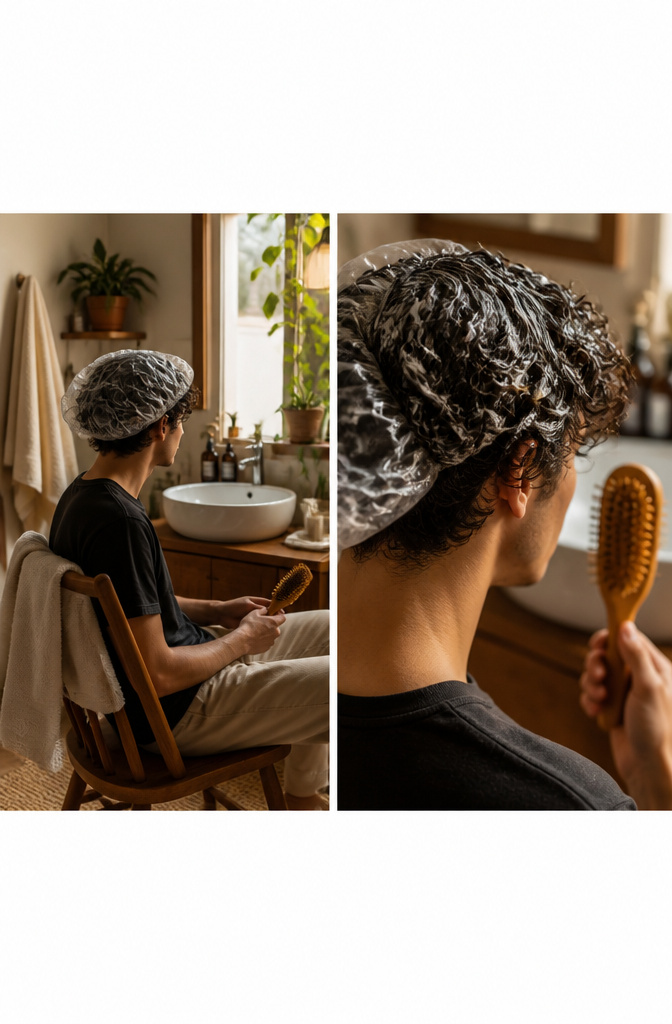
Daily conditioner coats the surface. A weekly deep conditioning mask gets inside the strand and stays there.
I started this after watching too many wash days where my curls looked full for an hour, then fell flat by noon. The difference is time and heat. Fifteen to twenty minutes under a shower cap lets the mask actually penetrate instead of rinsing down the drain in two minutes. A heat cap works better if you have one; a hair dryer held over the plastic cap does enough when you do not.
Application matters more than the brand. Work it through clean hair in sections, detangled with fingers or a brush, so every coil gets saturated. The shrink test is the reliable signal: when your curls pull up and hang shorter, the mask has done its job.
What changed was consistency, not product. Once a week built moisture memory into my hair, the way Dawan Pearson describes getting curls used to being moisturized. After a month the midday flatness stopped. The coils held their defined shape from morning until I pineappled them at night.
6. Detangle Without Breaking Curls

Wet hair is the only safe time to bring a comb anywhere near curls. I learned this the hard way in my early twenties, ripping a regular brush through dry waves and wondering why my bathroom mirror showed a cotton-candy halo instead of defined ringlets. Now I stick to a wide-toothed comb on soaking wet hair, working from ends upward in sections so the tugs happen where hair slips rather than snapping at the root.
Fingers work too, and some mornings that is all I use. Running them through conditioned hair lets you feel exactly where a knot lives and pick it apart without forcing, which matters because every forced tug breaks the curl pattern you are trying to build. Dry detangling shreds the cuticle, scatters frizz, and guarantees the definition you wanted will not show up. The comb or your fingers, the rule stays the same: water first, patience second, dry hair never.
7. Style with Scrunching and Finger Coiling

Scrunching works on any curl type from waves to coils, and it is the fastest way to form definition on wet hair. A mousse, curl cream, or gel goes in while your head is upside down or tilted, and you gather sections upward toward the scalp with a squeezing motion. The ends need more attention than the roots; product concentrated at the scalp leaves hair flat at the crown and stringy below. For uniform, rope-like curls, finger coiling gives control that scrunching does not. Small sections of clean, damp hair get wrapped around a finger with styling custard applied first, held for a few seconds, then released. It takes longer but the curl pattern stays precise once dry.
Gel sets hard, which protects the shape while hair dries. The cast feels crunchy and looks matte, so you scrunch out the crunch once it is fully dry by squeezing the same way without adding product, breaking the cast and freeing softer curls underneath. Skip this step and the style stays helmet-like. I learned the timing the hard way: touching gel too early breaks the hold and invites frizz, waiting too long can leave flakes if you used too much. Finger coiling suits anyone whose curls fall into inconsistent patches; scrunching suits anyone who wants volume and speed. Pick one, or finger-coil the front panels where hair faces the world and scrunch the rest for lift where it counts.
8. Protect Curls Overnight

Cotton pillowcases are silently undoing most of what the shower took twenty minutes to build. The fibers grip each curl, pulling it apart and lifting the cuticle so morning hair looks puffed rather than defined. Satin caps and pillowcases slide instead of grab, keeping the curl clump intact from wash day through day three at least.
I skipped this step for a full month last winter, convinced my hair was just "getting frizzier with age." The satin switch cost under fifteen dollars and changed more than the expensive refresher spray I was wasting trying to fix the damage each morning. The difference is friction physics, not marketing: cotton absorbs moisture too, which dry curls do not have to spare.
A cap keeps the style more compact if you move a lot in sleep; the pillowcase leaves you freer if a wrapped head feels constricting. Either works, but neither works if it stays in the drawer.
9. Trim Every 6 to 8 Weeks

Split ends travel up the strand faster than most guys expect, and by week six the shape of a curl starts to collapse where the tip has frayed. A trim every 6 to 8 weeks catches that damage before it tangles into the curl beneath it, which is what turns definition into frizz. The sources back a two-month schedule as the practical ceiling; push to three and you’re past the point where the cut preserves the pattern rather than rescuing it. What convinced me, reading through a dozen of these routines, is how many men blame their product or their technique when the real culprit is simply length they’ve held too long. The breakage doesn’t announce itself early. You’ll notice the loss of bounce first, or the way a coil that used to spring back now hangs in a stretched wave. By then the split has already moved upward. Keep the appointment narrow, too: just the ends, no restyle, so the shape you’ve built stays intact.
10. Adjust for Season and Length

Humidity and hair length shift what your curls need more than any product marketing will admit. In winter, I add a heavier leave-in layer because indoor heating pulls moisture out faster than summer air ever does. The conditioners that felt fine in July turn insufficient by January, so I bump up to something richer or apply twice the amount through the lower half of my hair.
Summer drops the opposite problem into my lap: products that worked all winter suddenly sit on top of my hair and flake by noon. I cut my leave-in by roughly half and skip oils entirely on humid days, because the air is already doing the hydration work.
Growing my hair from a short crop to collar length changed quantities more than it changed products. At two inches, a dime-sized blob of cream was enough. At six inches, that same spot needed two full palms to reach every curl without fighting tangles. The weight of longer hair also stretches the curl pattern; what coiled tightly at short length falls into looser waves that need lighter styling to avoid pulling the life out of them.
Curl Products That Actually Work

Six products carry most curly routines for men. I have watched friends layer three of these wrong and end up with either flat grease or straw, so placement in the sequence matters as much as the choice.
- Curl cream shapes and defines. Work it through damp hair after any rinse-out conditioner; it locks moisture in and dries soft enough that the curls still move.
- Leave-in conditioner is the lighter sister to curl cream, used on days when you rinse but do not shampoo. It goes on wet or damp hair and keeps the strand lubricated before anything else follows.
- Sea salt spray builds the foundation. Mist it on damp hair as a pre-styler; it adds volume and texture that later products can grab onto, and the salt thickens without the weight of cream.
- Styling gel finishes. On wet hair, a little gives natural hold; more layers lock the curl firmly into place. It is the difference between curls that survive humidity and curls that surrender by noon.
- Hair oil, argan oil being the common pick, smooths dryness and frizz either as a pre-styling treatment or a last dab on dry ends. It is especially useful if your curls kink or break at the tips.
- Deep conditioning mask is the weekly reset. Once a week, replace your regular conditioner with a concentrated mask to replace what heat, wind, and product buildup strip away. Porous curls break more easily; this is where you pay that debt back.
What to Avoid
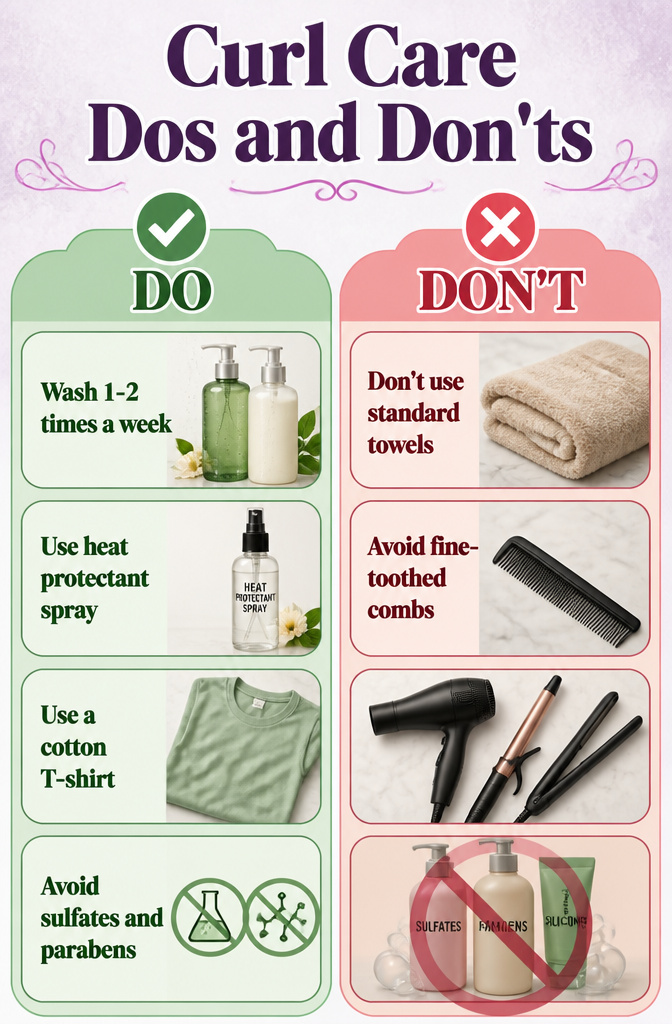
The habits that wreck curl definition before the product ever touches your hair are the ones that feel most automatic.
- Wash no more than 1–2 times a week. Every extra shampoo strips the sebum that keeps curls springy and close to the scalp, and sulfate-heavy formulas make it worse. When shopping, check the label for sulfates, parabens, and silicones. Sulfates lather hard because they are essentially detergents, same as dish soap; they pull moisture out faster than curly hair can replace it. Silicones coat the strand to fake smoothness, but that coating blocks water and conditioner from getting in, so over time hair goes flat and thirsty. Parabens are preservatives with enough dermatological baggage that skipping them costs nothing and removes a worry.
- If you reach for a blow dryer, curling wand, or straightener, heat protectant spray is non-negotiable. The sources agree on this even when they disagree on almost everything else: hot tools without protection wreck curl pattern and brittleness both. A diffuser on low heat is the compromise if air drying is not an option.
- That standard bath towel does surprising damage. Rubbing roughs up the cuticle and breeds frizz; a cotton T-shirt or microfiber towel pressed against the hair instead is the replacement.
- Fine-toothed combs snag and snap curls mid-strand. Fingers or a wide-toothed comb, working from ends upward, keep the spiral intact.
Moisturizing Against Hold
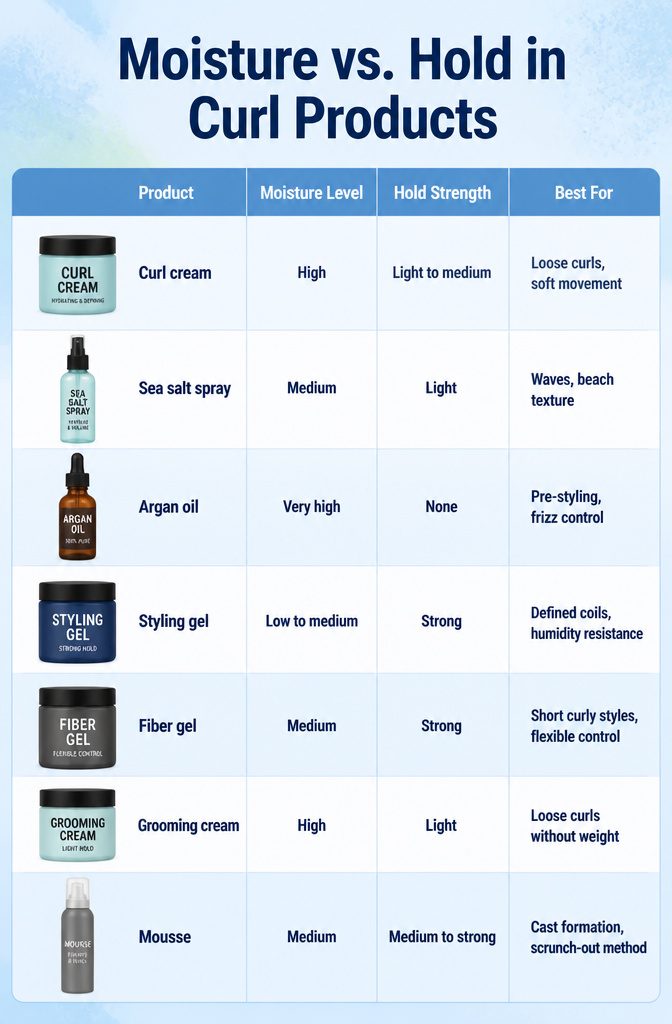
The real split in curl products sits between moisture and hold, not brand or price. Reading through what actually gets recommended for guys, I noticed the drier your curl pattern, the less hold you need to get definition that lasts.
Loose waves or early curls, 2A to 3A, move best with light hold plus moisture. A sea salt spray or a grooming cream gives enough structure without the crunch. Tighter coils, 3B and up, face more shrinkage and frizz, so the balance shifts: stronger hold from gels or fiber gels locks the shape in, but only if moisture comes first through leave-ins or argan oil pre-styling. Skip that base layer and the cast forms on dry, brittle hair that breaks instead of bounces.
The catalog groups this way in practice:
| Product | Moisture Level | Hold Strength | Best For |
|---|---|---|---|
| Curl cream | High | Light to medium | Loose curls, soft movement |
| Sea salt spray | Medium | Light | Waves, beach texture, volume base |
| Argan oil | Very high | None | Pre-styling, frizz control, sealing |
| Styling gel | Low to medium | Strong | Defined coils, humidity resistance |
| Fiber gel | Medium | Strong | Short curly styles, flexible control |
| Grooming cream | High | Light | Loose curls without weight |
| Mousse | Medium | Medium to strong | Cast formation, scrunch-out method |
Definition isn’t either-or. It builds from moisture upward. A gel cast on properly hydrated hair scrunches out to touchable shape. The same gel on dry hair stays stiff and flakes. The product labels say "curl defining," but the sources agree: definition is what happens when moisture meets the right hold for your pattern, not the product name printed on the jar.
Frequently Asked Questions
How often should I wash my hair if I have curls?
Stick to 1 to 2 washes per week. Shampoo strips the natural oils that travel down the shaft and keep coils from drying into frizz, so cutting back lets your scalp’s own sebum do the moisturizing work. On days between washes, a water rinse and gentle scalp massage is enough.
What products should I use for curly hair?
Build around curl cream, leave-in conditioner, and styling gel. Curl cream shapes and defines on damp hair after conditioning; leave-in acts as the moisture anchor before any gel or cream goes on; gel finishes with hold that survives humidity. Heavy oils and butters only suit coily types, while waves need lighter formulas.
How can I define my curls better?
Scrunching and finger coiling are the two techniques that form lasting definition. Scrunch product into wet hair by gathering sections upward toward the scalp; finger coiling wraps small damp sections around a finger for precise, rope-like curls. Gel sets hard to protect the shape while drying, then you scrunch out the crunch once fully dry.