

Wavy hair needs three to four washes a week, more than curls but less than the daily routine straight hair often demands. That frequency collapses the moment humidity climbs or sweat enters the picture, which is why my own summer schedule falls apart by Tuesday every single week. Celebrity stylist Melissa DeZarate draws the hard line at once weekly as an absolute floor; past that point, oil suffocates the follicle and waves have too little structure to hide it.
How Often to Wash Wavy Hair

Wavy hair sits at a tricky midpoint on the texture spectrum. It needs three to four washes a week, which is more than curlier types but less than the daily lathering straight-haired routines often push. The reason is straightforward: waves accumulate oil and product faster than tight curls, yet their looser pattern loses definition and moisture just as quickly. Wash too seldom and the wave falls flat under buildup. Wash too often and the strand swells, frizzes, and forgets it ever had a pattern.
Curly heads get by on two to three washes weekly, and coily hair typically thrives on one to two. Wavy hair does not have that luxury of time. The cuticle layer sits more open than straight hair but less sealed than a coil, so sebum travels down the strand just enough to look greasy at the roots while the ends stay parched.
Stylist Melissa DeZarate, who works with clients like Henry Golding and Andrew Scott, told GQ that in an ideal world she would have everyone wash every three to four days, with once a week as the absolute floor. For wavies, that three-to-four-day window lands right in the sweet spot.
"In an ideal world, I would say, wash your hair every three to four days… The bare minimum that I like to tell everyone is at literally the absolute bare minimum once a week."
Dragging it past seven days without at least a scalp scrub or detox shampoo leaves the follicle suffocating under its own oil, and waves have less structure to hide that collapse than curls do.
What Changes Your Washing Frequency

A baseline of three to four washes a week works for wavy hair only when your week is fairly tame. The moment humidity climbs or you start sweating regularly, that schedule collapses. Summer in my city means four consecutive months where my scalp produces enough sebum by Tuesday to wreck a wash that happened on Sunday. High humidity and heavy sweating push your count up, sometimes to daily or every-other-day washing, because sweat spreads oil down the shaft and clogs follicles in a way dry air simply does not.
Product buildup shifts things too. Wavy hair drinks up less moisture than tighter curls, so many of us compensate with heavier creams or hairsprays. The residue accumulates faster than it would on straight hair, weighing waves flat until they read as failed straight hair rather than textured. Clarifying every fourth or fifth wash helps, but if you are styling most days, your wash frequency likely needs to edge upward regardless of season.
Color processing or chemical damage runs opposite: dry, brittle strands demand pulling back, washing less to preserve what natural oil remains. The tension lives between scalp health, which wants regular cleansing, and shaft health, which wants to be left alone. You negotiate it by watching where the problem shows up. Greasy roots with dry ends mean washing more often but conditioning mid-lengths only. Itchy scalp or flaking means you have waited too long.
Hair Type Differences

Sebum travels farther and faster along wavy strands than it does through tight curls or coils. The bends in wavy hair are loose enough to let scalp oil slide down, but not tight enough to slow it to a crawl, so roots get greasy while ends stay parched; the same pattern that makes wavy hair prone to flatness at the crown and frizz at the bottom.
Curly and coily textures face the opposite problem. Tighter spirals and zigzags create friction that keeps sebum near the scalp, which means less frequent washing but more dryness through the length. Everyone still needs to rinse product out, just on different clocks.
| Hair type | Typical wash frequency | Main risk if you wait too long | Main risk if you wash too often |
|---|---|---|---|
| Wavy | 3–4 times per week | Root buildup, waves fall flat | Stripped ends, frizz |
| Curly | 2–3 times per week | Product accumulation | Disrupted curl pattern |
| Coily | 1–2 times per week | Scalp congestion, itching | Extreme dryness, breakage |
What counts as "too often" shifts with your texture. Stretch a wavy routine to once a week and the grease wins; push coily hair toward daily washing and the breakage does. The same sulfate-free shampoo paired with a clarifying wash every fourth or fifth rinse works across textures, but the gap between those clarifying days is what changes.
What to Wash With

Three product types cover the washing cycle for wavy hair, and switching between them matters more than choosing one perfect bottle.
Gentle or low-poo shampoos foam like traditional formulas but skip sulfates and harsh cleansers. They lift scalp oil and lighter product residue without stripping the waves that sit between straight and curly textures. For regular wash days, this is the workhorse: cleansing enough to reset the root area, mild enough that the drier ends do not crisp.
Co-washes trade most cleansing ingredients for conditioning ones. The product never foams, and that absence is the point: wavy hair needing frequent washing, or a scalp that trends sensitive, gets rinsed without the stripped, cotton-candy texture sulfate shampoos leave behind. Daily use is workable here, though not every head needs it.
Every fourth or fifth wash, clarifying shampoo melts away the buildup gentle formulas cannot touch. Silicones from styling products, hard water minerals, dry shampoo dust: it all collects at the root and drags waves flat. Used more often, the strongest cleanser in the rotation turns hair brittle; spaced correctly, it keeps the spring.
Apply any cleanser to the scalp and roots only. The runoff during rinsing handles the lengths. Targeting this way took me longer to accept than it should have, but the ends stopped drying out once I did.
Reading Your Scalp

Your scalp tells you when it needs washing, and that signal overrides any schedule you have written down. An oily feel at the roots, persistent itchiness, or visible product buildup are the three signs that mean cleansing is due. I ignored all three once after a long weekend of dry shampoo layering, thinking I was being kind to my waves. The itch turned into flaking, and the flakes were oily, not dry, which is the opposite of what I assumed. That buildup had blocked follicles enough to make my hair fall flat where it normally bounced.
Scalp health sits under your hair, literally. Skin there still needs care, and inflammation from skipped washes can lead to hair loss or breakage long before you see the problem on the strand level. Wash the moment redness, thick buildup, or even small breakouts appear, because those are warnings, not suggestions. When you do wash, work cleanser directly into the scalp and let it sit rather than rinsing immediately. The skin under your waves deserves the same attention you give your face.
How I Actually Wash Mine
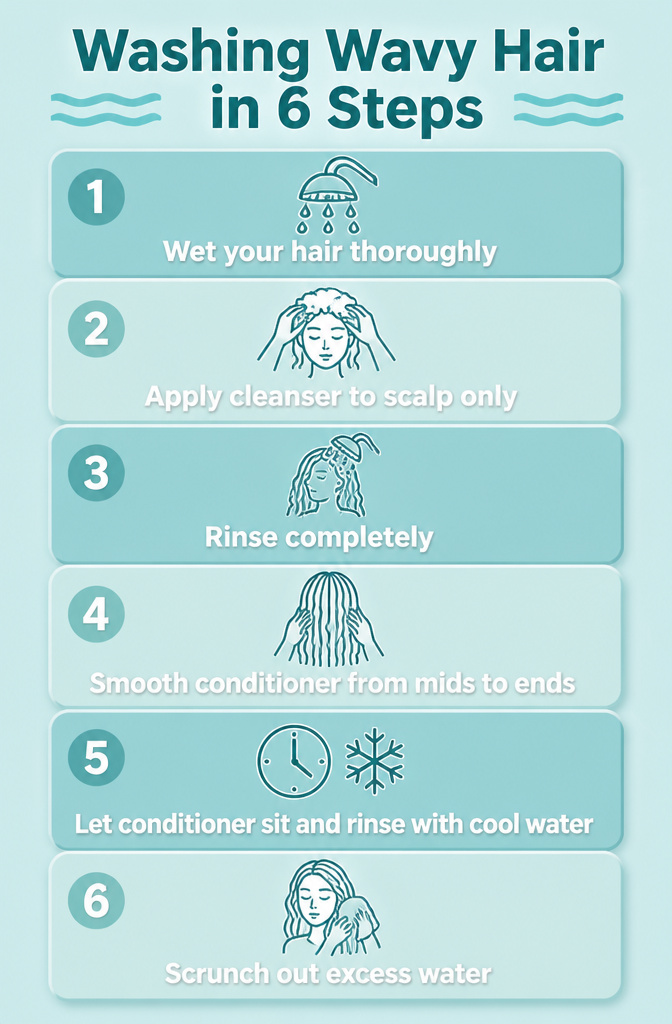
The washing method for wavy hair matters almost as much as how often you do it. After watching my own waves flatten or frizz depending on technique, this is the routine that actually holds up.
- Wet your hair thoroughly with warm water before any product touches it. Skipping this step leaves shampoo sitting on dry patches, and those patches end up greasy by noon.
- Apply cleanser to your scalp only, using your fingertips to work it in. AAD guidance says the same: the scalp produces oil; the lengths do not. Let the rinse carry the diluted cleanser downward rather than scrubbing shampoo through your midlengths.
- Rinse completely. Leftover cleanser weighs waves down and invites itch.
- Smooth conditioner from mids to ends, where the hair is oldest and most fragile. Skip the scalp unless yours is genuinely dry; too much near the roots and waves lose their spring.
- Let the conditioner sit while you finish showering, then rinse with the coolest water you can stand. Cool water closes the cuticle, which means less frizz and more defined waves once dry.
- Scrunch out excess water without rubbing a rough towel against the strands. A cotton t-shirt or microfiber cloth works here; terry cloth disrupts the wave pattern and creates the fuzz nobody wants.
Daily Washing Is Not the Answer

Daily washing strips more oil than wavy hair can afford to lose. Textured hair runs naturally drier than straight types, and shampooing every day leaves waves brittle, rough, and paradoxically harder to style. The scalp compensates for stripped moisture by overproducing sebum, so you end up with an oily root and parched ends far sooner than if you’d spaced washes out.
I learned this the hard way after years of treating my waves like the fine, straight hair I’d had as a teenager. The scalp kept pumping out oil to make up for what the daily lather removed, while the actual waves turned into a static tangle that refused to clump.
Most heads with wavy or curly texture do better on one to two washes weekly, though that shifts based on what the next section covers. The real risk isn’t hygiene, it’s throwing off the oil balance entirely until the hair feels damaged and the scalp feels greasy at the same time.
Frequently Asked Questions
How often should I wash my hair?
Wavy hair needs three to four washes a week, which is more than curlier types but less than straight hair. That frequency keeps oil and product from flattening waves without stripping the moisture that holds their shape. If your week involves heavy sweating or high humidity, you may need to wash more often; if your hair is color-processed or damaged, you may need to pull back.
Is it bad to wash your hair every day?
Daily washing is too much for wavy hair. It strips oil faster than the scalp can replace it, so the scalp overproduces sebum while the ends turn brittle and frizzy. Most wavy heads do better spacing washes out, using a gentle or low-poo shampoo when they do cleanse.
What products should I use for wavy hair?
Rotate three types: a gentle or low-poo shampoo for regular washes, a co-wash when you need to rinse without stripping, and a clarifying shampoo every fourth or fifth wash to melt buildup. Apply any cleanser to the scalp and roots only, letting the rinse carry diluted product through the lengths.